Total Pageviews

Sunday, April 24, 2016

Nifty Time Frame 75 Minute : Charts of January 2016

Quoting from an old blog
http://lalitlk-lalit-lk.blogspot.in/2014/12/nifty-index-time-frame-75-minutes.html

 Market in India is from 9:15 AM to 15:30 hours (3:30 PM) and of 375 Minutes duration. As such, a TF of 3 minutes cover a day with 125 candles, TF of 5 minutes covers 2 days, TF of 15 minutes cover 6 days & TF of 75 minutes cover in 30 days - all with 150 candles.

Traditionally, Daily chart  of around 30 weeks is of /around 150 candles. Fractal of daily chart is taken/accepted of being hourly, However, in my opinion , the hourly chart is asymmetrical in nature ; 1st candle depicted as 9:00 is based on 3 candles of TF  15, & 7th candle depicted as 15:00 is based on 3 candles of TF  15. Balance 5 candles (10:00 to 14:00 inclusive) are based on 4 candles of TF 15.  Best option for fractal is no doubt a TF of 75 minutes".


Thursday, April 7, 2016

Nifty : Monthly vs TF 21 DaysCycle

Traditional monthly Chart has an inherent shortcomings, viz., it has diverse time-wise duration ; it may be 20 days affair (in case of February) or as high as 23 days affair ( in case of 31 days Month). However, in a Time Frame of 21 Days Cycle it is fixed & uniform  time-wise duration


Notice Macd in the Monthly (above)  is still in positive territory over the last 3 months in 2016. However, it had drifted over the last 3 candles in negative territory in TF 21 DaysCycle (below). 


Saturday, March 12, 2016

Nifty : Step Sum Analysis (2004-16)


Further to introduction in my blog

http://lalitlk-lalit-lk.blogspot.in/2015/12/nifty-1995-2015-step-sum-analysis.html

Step Sum is in the form of a new technical tool to evaluate the psychology of the market. It has been developed by Mark Lundeen and it offers a unique insight into the psychology of the market.The step sum is a single item Advance – Decline Line. In other words; if Nifty is down from the previous day’s close, we give it a value of (-1), if they end the day up from the previous day’s close, we give it a value of (+1). So a step sum plot is merely the net sum of up and down market days over time.

15 day running sum of the daily steps used in constructing their step sums may be called “Count 15”   A “Count +/-  15”  means All 15 either Up or Down days in continuation


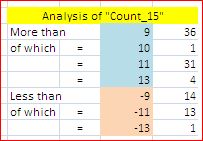
We are yet to see  “count 15” in Nifty , examined over 5076 days. Even counts exceeding “9” are just a few as displayed below :

, just 50 in total – literally just 1% of the total.

For a meaning full understanding of vast Data, a suitable filter was used. A number of positive “Count 15” – specially one after another - score up the step sum & a number of negative “Count 15” – specially one after another – drag down the step sum. A close examination of Chart is suggested for better understanding.


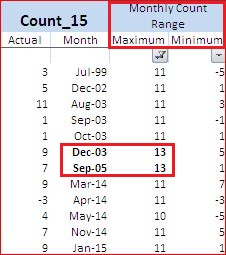
Three  Table incorporating Step Sum Count_15 exceeding 9 is being given :


Next Chart covering Nifty 2001-16 shows Step Sum with Nifty closing ; upper portion tries to depict the influence of "Count_15" (with out filter) in the built up of step sum aspect.


Next one covers 2004-16 with Step Sum (Daily basis) & MSS (Monthly Step Sum)

Monday, February 29, 2016

Step Sum Analysis of Nifty (As on 29/02/2016)


Had introduced the 'step sum' in my earlier blog :

http://lalitlk-lalit-lk.blogspot.in/2015/12/nifty-1995-2015-step-sum-analysis.html


 “15 Count” is  running sum of the daily step used in constructing their step sum over consecutive 15 days. Gold’s 15 count reached a few 10s and 11s over the past five decades but never higher. Then last November during the selling panic in the gold market it declined to a 13 for the first time ever.
Silver’s November bottom was even harder; its 15 count declined to -15. In other words the price of silver fell below its previous closing price every day for three trading weeks. That had never happened before, although just a few months before silver’s January 1980 market top we saw its 15 count reach +15 in September 1979, according to  Mark Lundeen.

Count +/-  13”  means 14 up (down) & 1 Down(up),
“Count +/-  11”  means 13 up (down) & 2 Down(up),
“Count +/-  9”  means 12 up (down) & 3 Down(up),
And so on
“Count +/-  1”  means 8 up (down) & 7 Down(up). I had examined the history of Nifty Index since 3rd November 1995 (the day from which OHLC is being compiled by NSE). My findings are shared as below :-

Out of 244 months (during 20 years 4 months), Nifty Step Sum Count_15 most were in the range of + 9 to - 9 as per Chart :


However, there were just 2 occasions of "13" count as StepUp


& just 5 occasions of "11" counts as StepDown 


& finally Step Sum Chart for Nifty (Monthly) over 20 years 4 months :


Nifty-bi-monthly-chart : Update as on 29/02/2016


Further to my observations as per my blog

http://lalitlk-lalit-lk.blogspot.in/2015/10/nifty-bi-monthly-chart-1996-2015-update.html

here is the latest Chart from October 1997 :


I am sharing crucial Macd (5,34,5) data  for certain days ; IMHO in these higher degree Elliot Wave , Nifty had done its peak  at 9119.20 thereby gaining 8344 from 775 in December 1996, time-wise taking 19 years 4 months ; Fibonacci 38.2% retrace level is 5932.
 Let us wait patiently for price actions to unfold in the present bears market. 


Friday, February 12, 2016

Nifty : Case for Holdings Long (17 years or more)


Theorem : An investor , holdings on to one's investment for 17 years or more, is on GAINS in spite of turmoils during the holding periods. (Source:   Prof. Jeremy Siegel ,  www.jeremysiegel.com )


Here is my analysis of percentage gains over 884 weeks in the NIFTY Chart -  Pre-March 1999 investors are enjoying their gains in the range of  436 to 908 % .


Based on the existing rewards


, I am looking forward to fresh high during September 2018 through April 2020 based on lows prevailing in the rectangle marked in the chart.

Present bear phase may be utilized to reap handsome rewards in 2 years 7 months. Let us see if the theorem proves itself


Wednesday, February 3, 2016

CNX-Nifty-index-time-frame-cycles-of-21 : Up date # 3


With out stating details of my data constructions, already shared in an early blog :

http://lalitlk-lalit-lk.blogspot.in/2015/10/cnx-nify-index-time-frame-cycles-of-21.html

here is my submission for NIFTY been topped out at 9119 vide chart as on 3rd February 2016 :


IMHO , Nifty at 6357 was in wave-3, 2253 in wave-4 & 9119 in wave-5.


"When the MACD is peaking above the zero-line after a strong move higher that indicates wave 3 is forming. If it is pulling-back after peaking, then it is probably forming wave 4. It is a requirement of wave 4 that it should lead the MACD to move all the way back down to below the zero-line. When 4 finishes the MACD starts rising again as wave 5 begins moving higher in the direction of the main trend. Wave 5 is indicated by the MACD crossing back above the zero-line again and forming a lower MACD high, thus signalling divergence with price which is expected to reach the wave 3 highs as a minimum expectation."
Quoting from https://blog.forex4you.com/how-i-use-macd-to-trade-elliot-waves/
I may recall here that Macd remained in negative territory at the start, was in range of 11 & 13 periods subsequently ; yesterday it dipped the zero line after a gap of  38 periods in confirmation of the Nifty being topped out at 9119